
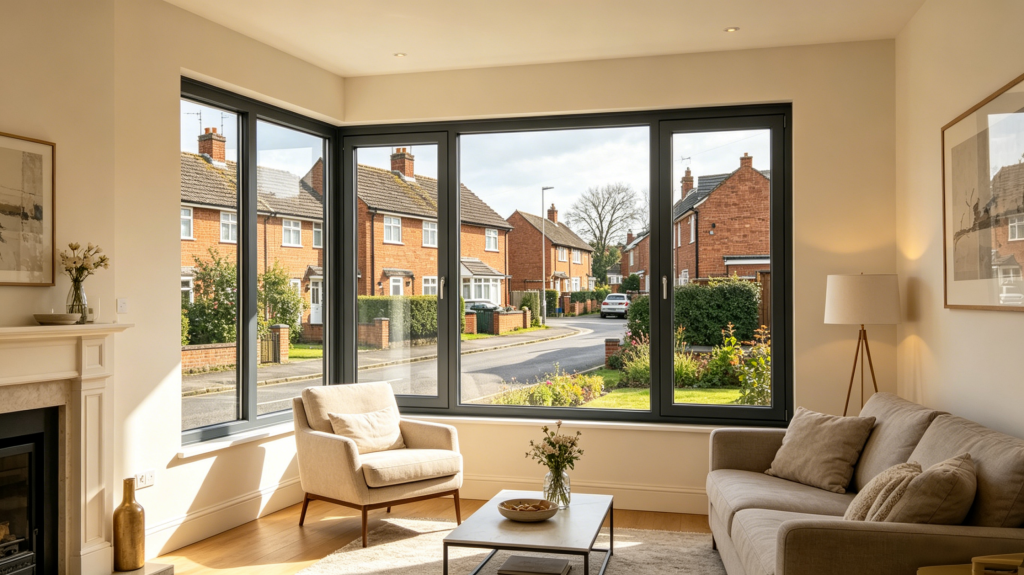
If you have been putting off replacing those draughty old windows, you have probably already come across the two main contenders: aluminium and uPVC. Walk down any suburban street in Britain today and you will see both — the white plastic frames that have dominated since the 1980s, and the slimmer, darker metal frames that have been steadily creeping into neighbourhoods over the past decade.
The question is not simply “which is cheaper.” If it were, the conversation would end with uPVC and this article would be two paragraphs long. The real question is which material suits your home, your long-term plans, and your priorities — because the differences go well beyond the price tag.
We install both. We have no vested interest in pushing one over the other — our job is to fit the right window to the right house. Here is what we have learned after years of doing exactly that.
This is the one that gets people first. uPVC windows are thick-framed by necessity. The material needs bulk for structural rigidity, which means the frame sections tend to be chunky — typically 70mm to 90mm across the face. On a typical semi-detached with modest window openings, that can easily mean 20-30% less glass area compared to what the original timber frames gave you.
Aluminium, being inherently stronger, can achieve the same structural performance with far slimmer sections — often as narrow as 40-50mm. That means more glass, more natural light, and a look that sits far closer to the original steel or timber crittall frames you see on period properties.
For modern homes and extensions, the difference is even starker. The slim sightlines of aluminium let you do things that are simply not possible with uPVC: floor-to-ceiling glazing, corner windows with no visible post, and expansive bifold or sliding door sets that feel almost entirely glass.
Bottom line: If your home is a Victorian terrace, a 1930s semi, a Grade II listed cottage, or a contemporary new-build with large glazed openings, aluminium will look right. uPVC tends to look its best on more modest post-war housing stock where the thicker frames do not detract from the architecture.
Here is a number that surprises most homeowners: a decent aluminium window, properly powder-coated, will still be doing its job in 40 to 45 years. We have pulled out aluminium frames installed in the early 1980s on coastal sites in Sussex and, bar some superficial chalkiness on the finish, the frames were structurally sound.
uPVC deteriorates differently. It does not rust or rot, which was its original selling point over timber. But it does discolour — the brilliant white of year one gradually shifts to a dull cream, then a yellowish grey, usually within 12 to 18 years depending on sun exposure. More importantly, the material becomes brittle over time. A uPVC frame that has been through twenty British winters has been through twenty cycles of thermal expansion and contraction. Eventually, the corner welds can fail, the seals harden and shrink, and the locking mechanisms start to feel loose.
Neither material needs painting — that is the one thing they share. But aluminium’s powder coating is a factory-applied finish baked on at around 200°C. It bonds at a molecular level. uPVC is coloured through the extrusion process, and while modern foils have improved dramatically, they can still peel or fade on south-facing elevations after a decade or so.
Bottom line: If this is your forever home, aluminium will probably outlast you. If you are planning to sell within 10-15 years, uPVC will still look presentable enough at that point — but a future buyer with an eye for detail will notice the difference.
A common assumption is that uPVC insulates better than metal. That was true in the 1990s. It is not true any more.
Modern aluminium windows use what is called a thermal break — essentially a reinforced polyamide strip inserted between the inner and outer aluminium profiles. This breaks the thermal bridge, stopping cold from conducting through the frame. A good thermally broken aluminium frame will achieve U-values of 1.2 to 1.6 W/m²K, which is comfortably within the requirements of Building Regulations Part L for both new builds and replacements.
uPVC frames, being naturally less conductive, achieve similar U-values without needing a thermal break — typically 1.2 to 1.4 W/m²K. So in practice, the two materials have converged. The glass unit itself (double or triple glazing) contributes far more to the overall window U-value than the frame material does.
The bigger difference is long-term airtightness. Aluminium does not warp. The seals stay seated in their grooves decade after decade. uPVC, over time, can bow slightly under repeated thermal cycling, creating micro-gaps that let in draughts — exactly the thing you paid to eliminate.
No window is truly “maintenance-free,” whatever the brochure says. But aluminium comes close. A wipe with warm soapy water twice a year is all it needs. The hinges and locks appreciate a spray of silicone lubricant every couple of years. That is it.
uPVC needs more attention, especially the white stuff. Dirt, algae, and traffic film cling to the slightly porous surface. You will find yourself scrubbing frames with specialist uPVC cleaner once or twice a year to keep them looking fresh. The seals around the opening sashes need checking more frequently — they are more prone to compression set (permanent flattening) than the EPDM gaskets used on aluminium systems.
One thing we tell every customer: if you live within five miles of the coast, aluminium is the only sensible choice. Salt-laden air will not touch it. uPVC near the sea tends to go brittle faster, and the hardware corrodes more readily.
This matters more to homeowners than it did five years ago. Aluminium is infinitely recyclable — the industry figure is that roughly 75% of all aluminium ever produced is still in use today. Recycling it uses 5% of the energy needed to produce primary aluminium. At end of life, an aluminium window frame can be melted down and turned into another aluminium window frame.
uPVC is more complicated. It can be recycled — there are specialist facilities in the UK that turn old frames into new profiles, pipes, and decking — but the recycling rate is far lower. Most old uPVC still ends up in landfill, where it does not biodegrade.
If embodied carbon and circular-economy credentials matter to you, aluminium has a compelling story — provided you go for a system that uses a decent proportion of recycled content in its billets.
There is no getting away from it: aluminium costs more upfront. The question is whether the premium pays for itself over the life of the window.
For a typical three-bedroom semi, you might expect to pay:
| uPVC (mid-range) | Aluminium (thermally broken) | |
|---|---|---|
| 8 windows + 1 door | £4,500 – £6,500 | £7,000 – £10,500 |
| Per window (average) | £400 – £600 | £600 – £900 |
| Bifold door set (3m) | £2,200 – £3,200 | £3,500 – £5,000 |
These are installed prices for Greater London and the South East as of mid-2026. Prices will be lower in the North and Midlands.
The aluminium premium is typically 40-60% on the initial outlay. Over 30 years, factoring in the longer lifespan, lower maintenance, and the fact that you will likely replace uPVC once in the same period, the gap narrows substantially. And if you factor in what an estate agent would call “kerb appeal at point of sale,” aluminium often ends up ahead.
Go for aluminium if: You are in a period property and want to preserve the original sightlines. You are in a modern home with large glazed areas. You are near the coast. You plan to stay in the house for 20+ years. You want colour choices beyond white (aluminium is powder-coated in any RAL colour — anthracite grey, sage green, and black being the current favourites).
uPVC might suit you if: Budget is the overriding concern. The property is a modest post-war house where the thicker frames are not visually intrusive. You expect to sell within a decade. The windows are on north-facing elevations where UV degradation of uPVC is slower.
When you replace windows, you live with the decision every single day. You look through them in the morning. You open them in summer. You feel the draught — or the absence of it — every winter evening. Saving a few hundred pounds per window only to spend the next twenty years noticing the bulkier frame and wishing you had gone slimmer is a false economy.
That said, if aluminium genuinely stretches your budget too far, a well-made uPVC window from a reputable manufacturer — fitted by someone who takes their time with the sealing and adjustment — will serve you perfectly well. The installer matters as much as the material.
If you would like to see both options on your own home — in situ, with no obligation — we offer a free home survey across England and Wales. We bring samples, take measurements, and talk through which products make sense for your property. No hard sell. Just honest advice from people who do this every day.
Glazing Southern Solutions installs premium aluminium and uPVC windows and doors across the UK. Based in London, we cover the whole Kingdom with a 10-year warranty on every installation.
Our specialist team delivers design, engineering and installation for commercial, residential and retail building envelopes across the UK.