
Most homeowners do not wake up one morning and decide to replace their windows on a whim. It creeps up. A draught here, a patch of condensation there — small things you learn to live with. Then one November evening the heating kicks in and the warmth vanishes before the radiators have even cooled, and you realise the windows have been quietly failing for years.
The trick is spotting the signs before winter does the job for you. Here are the five that matter.
This is the simplest diagnostic you can do right now. On a breezy day, walk around each window with the back of your hand. Hold it near the edges — where the frame meets the wall, where the opening sash meets the fixed frame, and along the bottom where the sill sits. If you feel cold air moving, you have a sealing problem.
What is happening is that the weather gaskets — the rubbery strips that compress when the window closes — have hardened and lost their spring. On older uPVC, they turn from flexible grey to brittle black. On old timber frames, the putty holding the glass in place may have cracked and fallen out altogether.
A failed seal does not just make you cold. It lets moisture-laden outside air into the cavity around the frame, which over time rots the timber subframe, stains the plaster reveals, and provides a highway for condensation. Left long enough, the cost of fixing the surrounding wall can exceed the cost of the new windows themselves.
Action: If you can feel draughts around more than two windows, do not bother replacing the seals alone — the frames have probably moved or degraded beyond what new gaskets can fix. Get a survey.
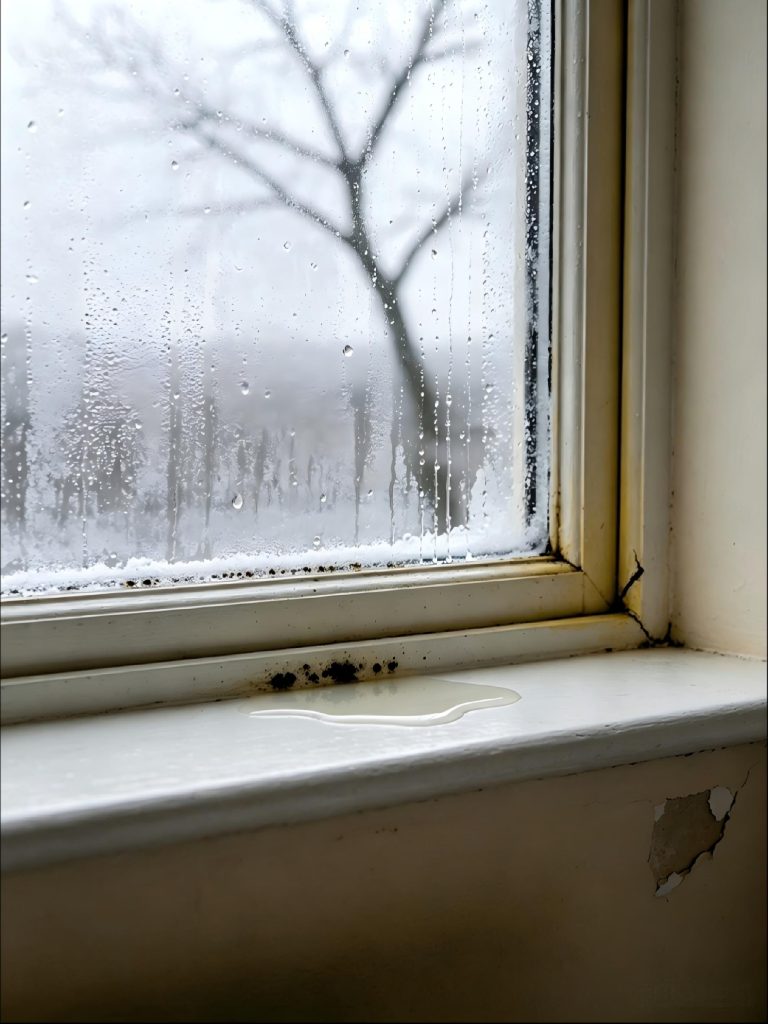
Condensation on the inside of the glass — the room side — is a ventilation problem. You are producing moisture (cooking, showering, breathing) and it is landing on cold glass. That is not a window fault; it is a humidity issue and usually solved by opening trickle vents or running the extractor fan a bit longer.
Condensation between the two panes of glass is a different matter entirely. That means the sealed unit has failed. The hermetic seal around the edge of the double-glazed unit — the black perimeter strip you can see if you look closely — has developed a microscopic breach. Moist air has entered the cavity, and now every time the sun hits the glass, the trapped moisture heats up and condenses on the inside face of the outer pane.
Once the seal has gone, the insulating gas (usually argon) has gone with it. The U-value of that unit has effectively reverted to what a single pane would give you. You are paying to heat air that escapes straight through the glass.
A failed unit can sometimes be replaced on its own without changing the whole frame. If one window has gone but the frames are otherwise sound — typically on aluminium frames less than 15 years old — ask your installer whether a glazing-only replacement is viable. If several units have failed, particularly on older uPVC frames, you are better off doing the lot.
Every window has a point in its life where it stops opening smoothly. At first it is just stiff — you have to give the handle a bit more muscle. Then it starts catching in one corner. Then one day you go to open it for the first warm Saturday of spring and it simply will not budge.
Windows go sticky for two reasons. The first is straightforward: hinges and mechanisms need lubricating, and most people never do it. A spray of silicone lubricant (never WD-40 — it attracts dirt) on the hinge pivots and locking points every year or two is all it needs. If lubrication solves the problem, your windows are fine.
The second reason is more serious: the frame has warped. uPVC expands and contracts with temperature. Over fifteen or twenty years of British weather — 30°C in summer, -5°C in winter — the cumulative movement can cause the frame to bow by a millimetre or two. That is enough to throw the sash out of square relative to the fixed frame. No amount of handle force will make a distorted frame fit properly, and forcing it will eventually snap the locking mechanism.
A quick test: open the window halfway and let go of the handle. If the sash stays put, the hinges are likely fine and the frame is the culprit.
This is the one that sneaks up. You do not notice the traffic getting marginally louder each year. Then a friend comes round, sits in your living room, and says, “It’s quite noisy here, isn’t it?” — and you realise you have been raising your voice to compensate without even knowing it.
Acoustic performance of windows degrades over time for the same reason thermal performance does: seals fail. Sound travels through air gaps, and the micro-gaps that cause a draught also let in noise. A window that was rated at 35 dB when installed — enough to reduce a busy road to a murmur — might be down to 28 dB or less after two decades. Every 3 dB drop means the outside world sounds twice as loud.
Modern aluminium windows with proper acoustic glazing — typically a laminated inner pane with a thicker outer pane and asymmetrical gaps — can achieve 38-42 dB reduction. For homes on main roads, near railway lines, or under flight paths, that is the difference between a bedroom you can sleep in and one you cannot.
If your heating bills have risen faster than the energy price cap, the building fabric is losing heat faster than it should. Windows account for roughly 18-25% of heat loss in a typical British home — more if they are old single-glazed or early double-glazed units from the 1980s with no low-E coating.
A simple infrared thermometer (about £15 from any DIY shed) will tell you more than you might want to know. On a cold day, point it at the wall — you might see 18°C. Point it at the centre of a double-glazed window — a healthy modern unit should read 14-16°C. If you are seeing 10°C or below, the glass unit has lost its insulating properties.
Then point it at the frame itself. An aluminium frame without a thermal break — common on commercial installations from the 1970s and 80s that found their way into residential buildings — will read barely above the outside temperature. Those frames are conducting heat out of your house as fast as the radiator can pump it in.
Individual failed sealed units on otherwise sound frames can be replaced — figure £120-£250 per unit depending on size and specification, including fitting. Stiff hinges and mechanisms can be serviced or replaced for £50-£120 per window.
But if three or more of the signs above apply to multiple windows in your home, you are in replacement territory. Chasing individual repairs on a system that is reaching the end of its service life is a losing game — you fix one thing and the next failure is already waiting.
The tell-tale that tips the balance: if the frames themselves are the problem — warped, brittle, or structurally deteriorated — no amount of new glass or new hinges will make them right.
Because every installer in the country is booked solid from September onwards. The first cold snap triggers a wave of enquiries, lead times stretch to eight or ten weeks, and you end up spending another winter with the heating on full and the draught excluders out.
If you start the process in summer, you have time to compare quotes properly, get the survey done at a relaxed pace, and have the installation completed while the weather is still mild enough that having a hole in the wall for an hour or two does not freeze the living room.
We offer a free, no-obligation home survey across England and Wales. We measure, we listen to what you actually need, and we give you a fixed price that does not change after the survey. If you are not sure whether your windows need replacing or repairing, we will tell you honestly — even if that means recommending a £15 tube of silicone lubricant instead of a £7,000 installation.
Glazing Southern Solutions provides window replacement, repair, and free home surveys across the whole Kingdom. Based in London with a 10-year installation warranty on every installation.
Our specialist team delivers design, engineering and installation for commercial, residential and retail building envelopes across the UK.